01
Claims Management
Claim Intake
Notices are routed, logged, categorized, and deadline-controlled.
USC replaces internal teams, software tools, and fragmented vendors with end-to-end unemployment claims management, compliance oversight, and professional representation nationwide.
Claims, hearings, benefit charge audits, SUTA rate protection, executive reporting, and cost visibility across all 52 U.S. jurisdictions.
Request a consultation See how it worksUSC manages the points where unemployment cost is won, lost, recovered, or reported.
Notices are routed, logged, categorized, and deadline-controlled.
Separation facts, employer evidence, RFIs, and documents are gathered.
Jurisdiction-specific responses and protests are filed on time.
Outcomes are reviewed and appealed when the record supports it.
USC handles prep, exhibits, representation, testimony, and follow-up.
Benefit charges are audited against claim outcomes, wages, and rules.
Charges, reserves, rate notices, penalties, and credits are reviewed.
Clients see activity, outcomes, dollars protected, and risk remaining.
A missed notice, weak response, skipped hearing, invalid charge, or unreviewed rate notice can move money in the wrong direction.
Every benefit charge should be audited against the claim record, determination, hearing outcome, wage data, return-to-work status, and state charging rules.
USC turns claim activity, charge audits, rate exposure, compliance gaps, and outcome reporting into visibility for HR, finance, and executives.
Request an exposure reviewUSC provides end-to-end unemployment services for employers, replacing internal teams, software tools, and fragmented vendors with fully managed unemployment claims management, compliance oversight, and professional representation nationwide.
Claims management, hearings and appeals, benefit charge audits, SUTA rate protection, executive reporting, and cost visibility across all 52 U.S. jurisdictions.
Your team gets visibility. USC handles the work.
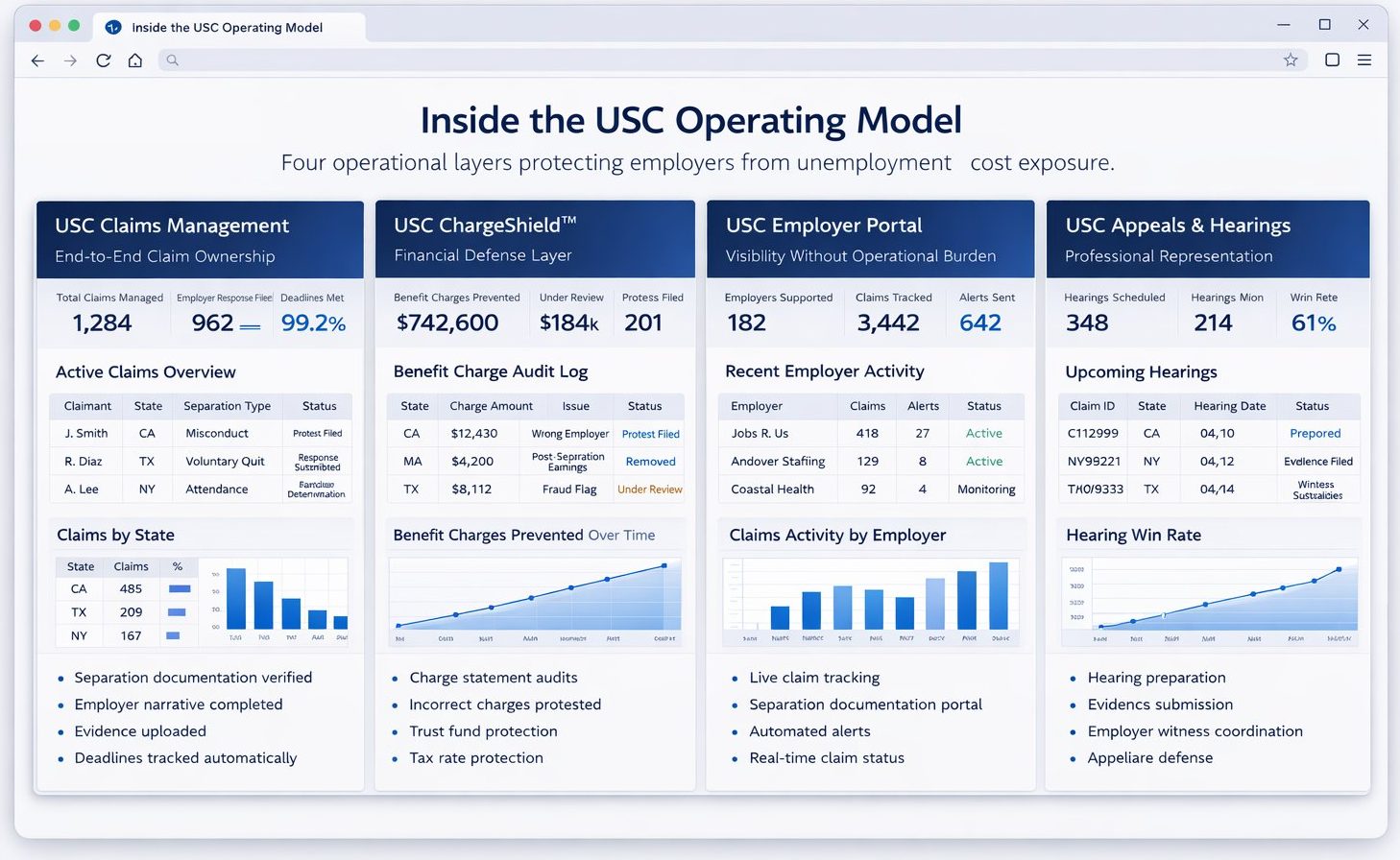
Most providers stop at claim intake. USC manages every stage where unemployment cost is created, contested, recovered, or compounded, from the first notice through the final rate calculation. Each step in the lifecycle below is owned, tracked, and reported by USC across all 52 jurisdictions.
Notices are routed, logged, categorized, and deadline-controlled.
Separation facts, employer evidence, RFIs, and documents are gathered.
Jurisdiction-specific responses and protests are filed on time.
Outcomes are reviewed and appealed when the record supports it.
USC handles prep, exhibits, representation, testimony, and follow-up.
Benefit charges are audited against claim outcomes, wages, and rules.
Charges, reserves, rate notices, penalties, and credits are reviewed.
Clients see activity, outcomes, dollars protected, and risk remaining.
Notices routed, logged, categorized, and deadline-controlled.
Separation facts, employer evidence, RFIs, and documents gathered.
Jurisdiction-specific responses and protests filed on time.
State adjudication reviewed and appealed when supported by the record.
Prep, exhibits, representation, testimony, and follow-up handled by USC.
Charges audited against claim outcomes, wages, and rules.
Charges, reserves, notices, penalties, and credits reviewed.
Clients see activity, outcomes, dollars protected, and risk remaining.
A missed notice, weak response, unfavorable determination, skipped hearing, invalid charge, or unreviewed rate notice can all move money in the wrong direction. USC manages the whole chain.
Claims management, benefit charge auditing, compliance oversight, and SUTA rate review belong in one program because each stage affects the next financial outcome.
Exposure enters through claim notices and missed responses.
Paid benefits are charged back to the account.
Charges reduce reserves and weaken experience rating.
Lower reserve ratios can increase future SUTA rates.
The next annual rate determines next year's cost.
Every benefit charge should be audited against the claim record, determination, hearing outcome, wage data, return-to-work information, and state charging rules. Invalid charges should be protested before they inflate reserve and rate exposure.
USC gives HR, payroll, and finance one accountable partner for the work that drives unemployment cost. Read the complete employer guide →

Every notice received, categorized, responded to, and tracked through resolution.
Outsourced unemployment claims management
Professional appeal and hearing defense without pushing preparation back to the employer.
Unemployment hearing representationLine-item charge validation, protest workflow, recovery tracking, and net exposure reporting.
Benefit charge audit by ChargeShield
Rate notices, reserves, credits, penalties, and state account exposure reviewed for financial impact.
Unemployment cost management services
Dashboards and reports that show claim activity, outcomes, charges, exposure, and next actions.
Portal visibility and reporting
State account access, filings, balances, POA/TPA setup, and penalty risks surfaced before they compound.
Compliance and risk managementExplore unemployment cost management support by industry, jurisdiction, employer structure, and operating model.
USC turns claims activity, charge audits, rate exposure, compliance gaps, and outcome reporting into clear visibility for HR, finance, and executive teams.
Real results delivered to real employers. Not projected. Not theoretical.
Payroll bundles from ADP, Paychex, and similar HCM platforms give you a login to their portal and leave you to do the work. Managing state portals, responding to SIDES requests, preparing for hearings, and chasing deadlines across multiple jurisdictions is all on your HR team. Legacy unemployment claim shops rely on paper forms, fax-and-mail communication, and keep you heavily involved at every step, gathering separation documents, prepping testimony, and tracking state deadlines yourself. Neither model cares about your benefit charges, your SUTA tax rate exposure, or your total unemployment costs. They stop at intake. USC doesn't. We manage the entire unemployment claims process from the moment a claim is filed to the final charge resolution, contesting every protestable claim, representing you at every hearing, auditing every benefit charge, and fighting for your bottom line across all 52 U.S. jurisdictions.
Unemployment claims management is the process of receiving, reviewing, responding to, and contesting unemployment insurance claims filed against an employer. It includes initial claim intake, documentation gathering, filing timely protests, representing employers at hearings, and auditing benefit charges to protect SUTA tax rates. Professional firms like USC handle this entire process on behalf of employers across all U.S. jurisdictions.
USC reduces unemployment costs through four mechanisms: contesting invalid claims before they become chargeable, representing employers at hearings on protestable claims, auditing every benefit charge statement through ChargeShield™ to identify and recover overcharges, and proactively managing SUTA tax rate exposure. Since 1976, USC has helped employers avoid over $1 billion in unemployment liability.
SUTA (State Unemployment Tax Act) is a payroll tax employers pay to fund state unemployment insurance programs. Your SUTA tax rate is directly affected by the number and cost of unemployment claims charged to your account. More claims mean a higher rate, which can cost tens of thousands of dollars annually. USC actively manages this exposure by contesting invalid charges, winning hearings, and auditing benefit charge statements to keep your rate as low as possible.
ChargeShield™ is USC's proprietary benefit charge auditing and recovery system. It reviews every benefit charge statement issued to an employer, validates each reimbursable bill, and files protests on avoidable charges before they impact the employer's SUTA tax rate or trust fund balance. ChargeShield™ operates in four layers: charge intake, validity audit, protest filing, and recovery reporting. It typically avoids 55–88% of exposed liability for USC clients.
Yes. USC provides professional legal representation at every level of the unemployment hearing and appeals process. USC appears on behalf of the employer, so the employer does not need to prepare testimony, gather documents, or attend. USC's hearing representatives have jurisdiction-specific expertise across all 52 U.S. states and territories.
USC provides full unemployment claims management coverage across all 52 U.S. jurisdictions, including all 50 states, the District of Columbia, and Puerto Rico. This includes both contributory and reimbursable employer types, multi-state operations, and complex EIN structures.
USC serves employers across all industries, with particular depth in high-turnover sectors where unemployment exposure is greatest: healthcare systems, staffing and temporary employment agencies, retail chains, hospitality and food service, logistics and distribution, manufacturing, and professional services. USC scales from 50 employees to 50,000+.
Payroll providers like ADP and Paychex treat unemployment as a checkbox feature: they file SIDES responses and stop. They do not contest charges, do not represent employers at hearings, and do not audit benefit charge statements. USC is a full-service unemployment claims management firm that owns the entire process end-to-end: claim intake, strategy, documentation, hearing representation, charge auditing, recovery, and compliance oversight across all 52 jurisdictions.
USC pricing varies based on employer size, claim volume, and state distribution. USC offers a free SUTA Exposure Review, a no-cost, no-obligation analysis of your current claims activity and unemployment costs, so employers can see exactly where they stand before making any commitment. Contact USC at 781-246-0262 or visit uscorp.com/contact to request a review.
USC (Unemployment Services Corporation) was founded in 1976 and is headquartered in Mashpee, Massachusetts. With five decades of experience, USC has helped employers avoid over $1 billion in unemployment liability and has built jurisdiction-specific expertise across all 52 U.S. states and territories.
Yes. USC specializes in multi-state unemployment claims management for employers operating across multiple jurisdictions. Each state has different rules, deadlines, hearing procedures, and charge protest windows. USC maintains jurisdiction-level expertise in all 52 U.S. jurisdictions and manages the full process centrally: one partner, one contact, consistent execution regardless of how many states you operate in.
No. USC operates as a zero-burden model. Once onboarded, all unemployment claim notices are routed directly to USC. USC handles intake, documentation, strategy, hearings, appeals, charge auditing, and compliance. The employer has no administrative tasks. Employers maintain full visibility through USC's real-time employer portal but are not required to take any action.
SIDES (State Information Data Exchange System) is the electronic system used by state workforce agencies to exchange unemployment claim information with employers and their authorized representatives. USC is a registered SIDES participant and receives claim notices electronically for faster response times. However, unlike payroll platforms that only respond to SIDES requests, USC goes far beyond, managing the full claims lifecycle including hearings, appeals, charge audits, and compliance oversight.
USC typically completes onboarding within 2–4 weeks depending on employer size and state distribution. The process includes establishing third-party administrator (TPA) authorization in each state, setting up claim routing, loading historical data, and configuring the employer portal. USC handles all state filings and paperwork. The employer's involvement during onboarding is minimal.
The Free SUTA Exposure Review is a no-cost, no-obligation analysis of your current claims activity, internal costs, and where USC can protect you.