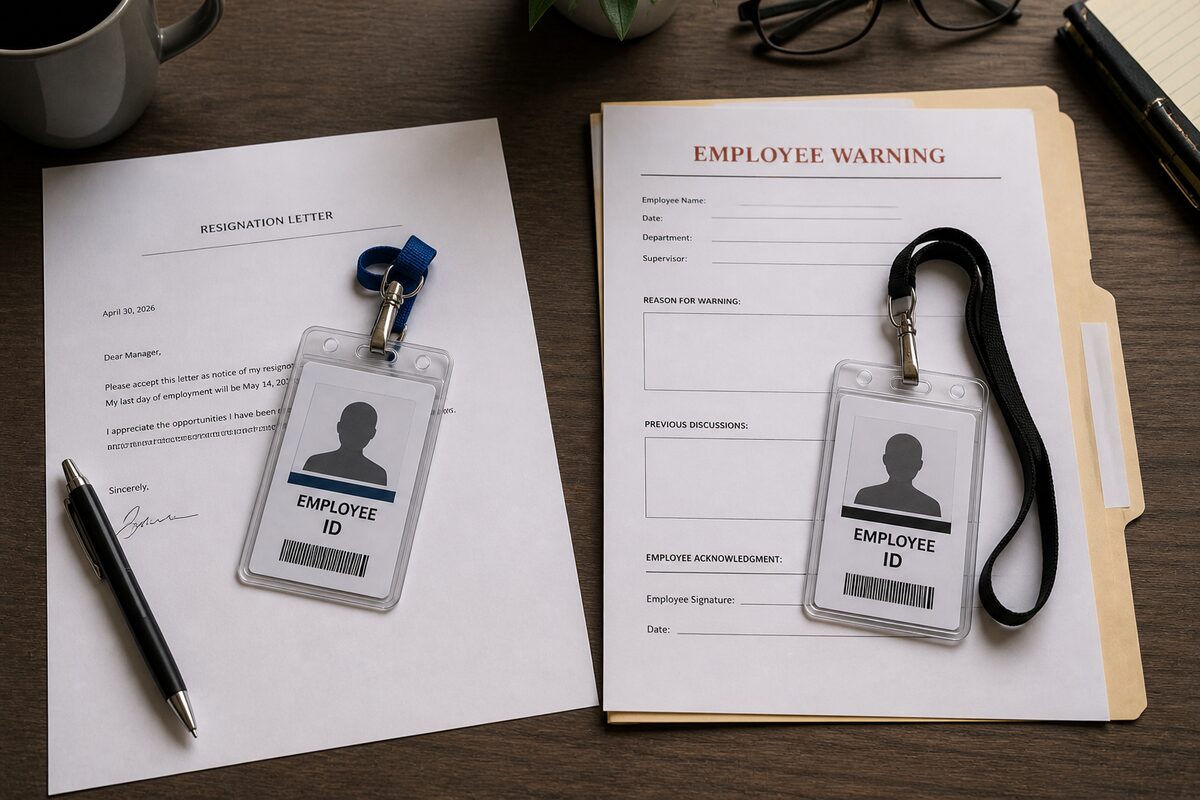
Why This Distinction Matters: The Cost of Getting It Wrong
Voluntary quit vs. misconduct is the central distinction that determines whether a former employee qualifies for unemployment benefits, and whether your account gets charged. A voluntary quit (employee leaves without good cause) generally bars benefits. Misconduct (employee terminated for willful policy violation) also bars benefits. Both require documented proof at the hearing.
Two employees separate from your company. Both file for unemployment benefits. One claims she had "good cause" to leave on her own. The other contests your termination, saying he wasn't violating any rules. The state will pay one claimant from your experience rating, and the decision rests entirely on whether your separation was classified as a voluntary quit or misconduct.
This distinction determines whether the employer or the state's unemployment trust fund bears the cost. It affects your experience rating for 18 months. It shapes whether your company can successfully defend against charges in an appeal hearing. And it signals to regulators whether your termination practices are defensible or exposed.
"Employers often conflate 'performance problems' with 'misconduct.' That confusion costs hundreds of thousands in unnecessary unemployment claims. Misconduct requires willful or deliberate violation, not just underperformance."
Understanding the legal definitions and burden of proof for each is not optional. It is the foundation of every separation conversation, every termination letter, and every response to a state unemployment claim.
Voluntary Quit: Legal Definition and Burden of Proof
A voluntary quit occurs when an employee initiates the separation: they resign, retire, or quit without employer pressure to do so.
The critical legal principle: In a voluntary quit case, the burden of proof rests on the claimant to demonstrate they had "good cause" for the separation. Good cause is narrowly defined as a cause attributable to the employer, not personal circumstances of the employee.
What Qualifies as "Good Cause" to Quit?
Most states recognize good cause in scenarios like these:
- Unsafe working conditions: documented OSHA violations, failure to provide required safety equipment, or hazardous exposure not addressed after notice
- Substantial reduction in pay or hours: a material change in the employment contract not voluntarily accepted by the employee
- Severe harassment or discrimination: documented unwanted conduct based on protected class, not reprimanded or corrected by employer
- Refusal to follow an illegal or unethical directive: e.g., employee resigns rather than commit fraud or violate law, as instructed by employer
- Breach of contract by employer: failure to pay wages, violation of agreed terms, major change in role without notice
What does NOT qualify as good cause:
- Poor management style or personality conflict with supervisor
- Disagreement with company policy or business decision
- Desire for higher pay (absent contract breach)
- Family or personal hardship (e.g., sick family member, need to relocate)
- Job boredom or lack of advancement opportunity
- Desire to pursue another opportunity
The Employee's Burden: They Must Prove It
In a voluntary quit case, the state agency adjudicator will ask: "Did the claimant prove good cause attributable to the employer?" The burden shifts to the employee. They must present evidence, written complaints, testimony about unsafe conditions, payroll records showing hour cuts, that their resignation was justified by employer conduct.
If the employee cannot meet this burden, the state will disqualify them from benefits, even if they resigned. Your role is to listen carefully during the hearing, not argue, and let the claimant's testimony speak for itself.
Misconduct: Legal Definition and Burden of Proof
A misconduct termination occurs when the employer initiates separation for cause. The employee violated a rule, failed to meet expectations, or engaged in conduct the employer deemed unacceptable.
The critical legal principle: In a misconduct case, the burden of proof rests on the employer. You must prove the employee engaged in "willful and deliberate" violation of reasonable employer rules or expectations. This is a HIGH bar.
What Constitutes "Willful and Deliberate" Violation?
Willful and deliberate means the employee:
- Knew the rule or expectation (it was communicated clearly and consistently)
- Deliberately chose to violate it anyway (not an accident, not confusion, not lack of understanding)
- Acted with awareness of the consequences
Examples of conduct that typically rise to misconduct level:
- Insubordination: direct refusal to follow a reasonable, lawful employer directive after being informed of consequences
- Theft or fraud: dishonest conduct for personal gain
- Violence, threats, or illegal conduct: on or off premises, that creates safety or reputational risk
- Gross negligence or recklessness: conduct so careless it shows disregard for the job or others' safety (e.g., operating machinery while intoxicated)
- Repeated violations after warning: documented pattern of rule-breaking despite prior discipline
- Breach of trust: violation of fiduciary duty, disclosure of confidential information, or violation of non-compete when reasonably enforceable
What Does NOT Constitute Misconduct
This is where the #1 employer misunderstanding lives: Poor performance is NOT misconduct.
If an employee is trying but struggling, missing deadlines, making errors, producing below-standard work, that is poor performance. It may justify termination, but it does NOT rise to the level of willful misconduct in most jurisdictions. The employee is not willfully violating a rule; they are failing to meet expectations despite good-faith effort.
Similarly:
- Inability to perform: lack of skill, aptitude, or mental/physical capacity is NOT misconduct, even if it leads to termination
- Unintentional error or accident: a mistake, even a costly one, is not misconduct if the employee was not deliberately reckless
- Violation of policy employee didn't know about: if the rule was not adequately communicated, it cannot support a misconduct termination
- Policy violation in first offense without prior warning: most states require warning or progressive discipline for misconduct, unless the violation is egregious (theft, violence)
The Grey Areas: Constructive Discharge, Job Abandonment, and Mutual Separation
Constructive Discharge: When "Voluntary" Quit Becomes Employer Liability
A constructive discharge occurs when the employer creates working conditions so intolerable that a reasonable employee would feel forced to resign, even if technically the employee initiated the separation.
Examples: persistent sexual harassment ignored by management, severe safety violations unaddressed after notice, unilateral major change in job duties or pay structure, targeted retaliation for reporting compliance violations.
The legal outcome: Even though the employee resigned (voluntary quit), the state may treat it as an employer-initiated separation if conditions were intolerable. This shifts the burden back to the employer to justify the conditions or the "lack of choice" the employee faced.
Prevention: Take complaints of intolerable conditions seriously. Document your response. If an employee raises a safety concern, harassment allegation, or contract breach claim and then resigns, preserve all communication and your remedial steps.
Job Abandonment: When Voluntary Quit Meets Misconduct
Job abandonment occurs when an employee simply stops showing up without notice or authorization, and does not return after reasonable attempts by the employer to contact them.
Legal treatment varies by state: Some treat abandonment as voluntary quit (employee initiated by not showing up). Others treat it as misconduct (willful breach of duty to notify). A few require the employer to prove the employee intended to abandon the job, not merely miss shifts.
To establish abandonment defensibly:
- Document all no-call/no-shows with dates and times
- Document all contact attempts (calls, texts, emails, certified letters) and the response (or lack thereof)
- Specify the timeframe: typically 2-3 consecutive absences without contact, or a pattern established in your policy
- Issue a written notice to last known address before terminating, stating: "If you do not contact us by [date], we will consider you to have abandoned your position."
- Preserve the employee's response (or documented silence)
Mutual Separation Agreements
When an employer and employee agree to part ways (the employer offers a severance or resignation incentive), courts treat this as a resignation initiated by the employee, unless the agreement explicitly states otherwise.
However, if the employer coerces the resignation (threatens termination without cause unless the employee resigns) or creates conditions that leave the employee no real choice, courts may recharacterize it as an employer-initiated termination, shifting burden of proof to the employer.
Best practice: If offering a severance-for-resignation deal, ensure the employee has time to consider, opportunity to consult counsel, and no threat of immediate termination. Document the employee's acceptance as voluntary.
State-by-State Variations: The No-Uniform-Rule Problem
Unfortunately, there is no federal unemployment law definition of "misconduct" or "good cause." Each state legislature and its courts define these terms differently. This creates three major variations:
Variation 1: How Strictly Is Misconduct Defined?
Strict states (CA, NY, IL): Misconduct requires deliberate, knowing violation with awareness of likely consequences. Poor performance, unintentional error, and inability to perform do NOT qualify. Burden on employer is high.
Moderate states (TX, FL, OH): Misconduct includes knowing violation AND gross negligence or recklessness. Poor performance still does not qualify, but carelessness rises to misconduct more easily. Burden remains on employer.
Broader states (WI, SC, KS): Some define misconduct to include "substantial disregard for the employer's interests," which can capture repeated poor performance after warning, or unreliability.
Variation 2: Does Progressive Discipline Matter?
Some states (CA, MA, NJ): Expect or require progressive discipline (warning, then escalating discipline) before termination for non-egregious violations. Failure to follow this process can undermine misconduct claim.
Other states (TX, FL, AZ): Do not require progressive discipline if the violation is serious (theft, violence, insubordination). Even first offense can be termination for cause.
Action item: Check your state's burden-of-proof standard. USC can provide state-specific guidance; consult before proceeding with any high-stakes termination.
Variation 3: What Counts as Adequate Notice of Rules?
Employee handbook required (most states): The rule must be in writing, distributed to employee, and employee must have acknowledged receipt. Email communication may be sufficient if forwarded with opportunity for employee to confirm receipt.
Oral communication insufficient: In most states, telling an employee a rule verbally does not satisfy notice requirement unless employer can prove the employee clearly understood and acknowledged the rule.
Documentation Requirements: Building Your Defensive Foundation
The strength of your misconduct defense rests entirely on documentation created at the time of the incident, not after a claim is filed.
For Voluntary Quit Cases: What You Need
- Resignation letter or email from employee, ideally stating they are resigning voluntarily
- Resignation intake form asking the employee why they are leaving, recorded in real-time
- Performance record showing employee was meeting expectations (if termination was NOT for cause)
- Record of any separation conversation with witness names and date
- Offer letter or contract proving the terms of employment, if the employee claims breach
For Misconduct Cases: What You Must Have
- Written employee handbook with the specific rule violated, distributed and acknowledged by employee
- Incident report written within 24 hours of the violation, including: date, time, location, specific behavior observed, who witnessed it, what rule/expectation was violated, and immediate impact (safety, legal, business)
- Progressive discipline records (if applicable in your state): dated written warnings, corrective action plans, meeting notes, employee acknowledgment and response
- Witness statements from colleagues or supervisors who observed the violation, signed and dated
- Communication with employee about the violation: email, meeting notes, or formal notice, stating the rule, the violation, consequences, and opportunity to respond
- Termination letter specifying the reason (misconduct), the rule violated, the date(s) of violation, and reference to the employee's opportunity to respond
- Performance reviews (if relevant) showing the employee's awareness of expectations
What NOT to Do (Creates Evidentiary Problems)
- Do not write incident reports after the fact or "fill in details later." Reports written weeks after the incident lose credibility.
- Do not include subjective judgments ("lazy," "attitude problem," "not a team player") without specific examples.
- Do not reference incidents the employee was not disciplined for at the time (inconsistent enforcement weakens your case).
- Do not terminate without giving the employee a chance to respond (unless the violation is egregious and the employee is a safety risk).
- Do not make retroactive policy changes to justify a termination.
Practical Scenarios: How the Distinctions Play Out
Scenario 1: "I Couldn't Handle the Stress"
Employee quits after 3 months, citing stress and long hours as reasons for resignation.
Legal classification: Voluntary quit. Burden on employee to prove the hours or stress were attributable to the employer's breach, e.g., employer promised 40 hours per week but scheduled 60, or workload was unreasonable and unsafe.
If employer has no defense: Simply having a stressful job does not disqualify the employee. Stress is a personal challenge, not an employer violation.
Outcome: If the employee's testimony is credible that the employer knew the workload was unreasonable and did not address it, the state may allow benefits. If the employee simply could not handle the job, benefits are denied.
Scenario 2: "He Didn't Show Up for Two Days"
Employee misses two days without notice or response to supervisor calls.
Legal classification: Employer terminates for abandonment or no-call/no-show policy violation. Burden on employer to prove employee knew the policy and deliberately violated it.
What matters: Did the handbook cover the policy? Did the employee acknowledge it? Did the employer attempt to contact the employee and document the attempts? Did the employer give the employee a chance to explain (sudden illness, emergency)?
Risky scenario: Employee was hospitalized with a medical emergency and did not call. Employer terminated for no-call/no-show. State may disallow misconduct claim because employee could not reasonably call, and employer failed to inquire about the absence. Better outcome: Allow the employee to provide a doctor's note; reinstate or acknowledge force majeure (unforeseeable circumstances).
Scenario 3: "Her Numbers Weren't Good Enough"
Sales employee missed targets for two quarters. Employer terminates for "failure to perform."
Legal classification: Not misconduct. Termination for poor performance or inability to perform.
What the employer should have done: Place employee on performance improvement plan with specific metrics, timeline (30-60 days), and support (training, mentoring). Document the plan, the employee's effort, and final performance outcome.
Unemployment outcome: State will likely allow benefits because the employee was trying but failing to meet expectations. Absence of gross negligence or deliberate rule violation means no misconduct disqualification.
Scenario 4: "He Refused a Direct Order"
Supervisor directed employee to follow a specific procedure. Employee refused, citing disagreement with the approach.
Legal classification: Insubordination, potential misconduct, IF the order was lawful, reasonable, and clearly communicated.
What matters: Was the order lawful and related to job duties? Was it clearly communicated? Did the supervisor give the employee a chance to ask questions or object before terminating? Was the refusal deliberate and knowing?
Risky scenario: Manager gave a verbal order; employee misunderstood and thought she was following alternative instructions from another manager. Termination for insubordination fails because employee did not deliberately defy the order. She acted on confusion.
Better scenario: Manager gave clear written instruction. Employee refused in writing. Manager restated the directive and explained consequences. Employee refused again. Termination for deliberate insubordination is defensible.
Separation Documentation: Timing Is Everything
Create a separation checklist and follow it for every termination:
- Day of incident (or day of discovery): HR or supervisor writes incident report, within 24 hours, with specific facts and rule violated.
- Same day or next business day: Meet with employee to explain the violation, hear their response, and document the conversation.
- Within 3-5 business days (unless egregious): Issue progressive discipline (verbal warning, written warning, suspension) or termination letter.
- If terminating: Termination letter must specify reason, rule violated, and dates. Allow employee to respond in writing if not egregious.
- Upon separation: Conduct exit interview, document how resignation or termination was communicated, and file all documents in personnel file.
- If claim is filed: Gather all documentation (handbook, incident reports, discipline, performance reviews, witness statements) and submit to state within response deadline (usually 10-14 days).
Multi-State Variations: Know Your Exposure
If your company operates in multiple states, each state has its own misconduct and good-cause definitions. A termination defensible in Texas may not be defensible in California. A resignation that triggers benefits denial in Florida may trigger benefits approval in New York.
When planning a high-stakes separation (termination for misconduct, contentious resignation), consult your state-specific legal standard before proceeding. USC can provide:
- State-by-state misconduct definitions and burden of proof
- Required progressive discipline standards
- Notice requirements for policies
- Preferred documentation formats for your state(s)
Defend Your Separation Decisions with Confidence
USC's Legal and Claims Defense team reviews your termination documentation, advises on state-specific burden of proof, and represents you at unemployment hearings to defend your misconduct claims. Let us help you build an airtight separation file from the start.
Schedule a Defense Review