Unemployment Claims Management:
The Complete Employer GuideFully managed by USC. Nothing missed.
USC processes, tracks, and defends every unemployment claim filed against your organization, from initial notice to final resolution, so your HR team can focus on running the business.
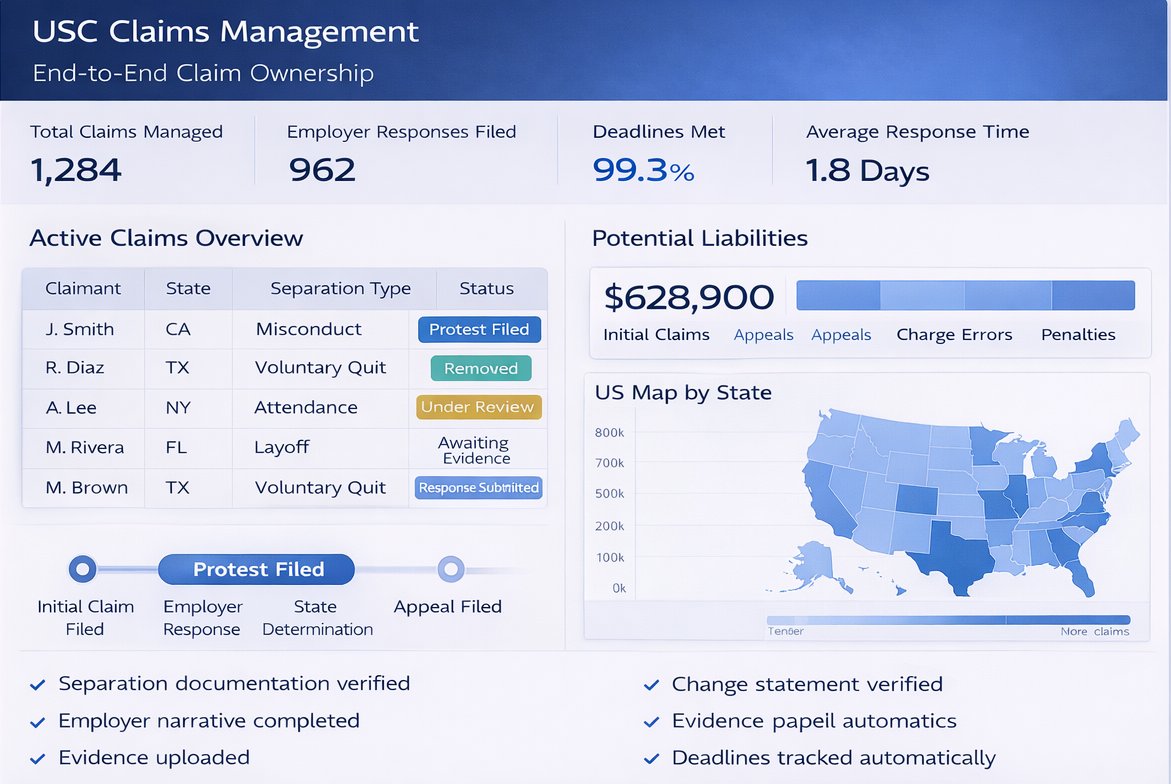
USC files the response.
USC resolves the claim.
Most employers scramble to meet state deadlines, track separation details, and draft responses across dozens of jurisdictions. USC intercepts every unemployment claim at intake, responding on time, building the case, and driving it to resolution so your HR team never touches it.
What Is Unemployment Claims Management?
Unemployment claims management is the end-to-end process by which an employer receives, responds to, and defends unemployment insurance claims filed by former employees, from the initial state notice through determination, appeal, and hearing, while auditing the benefit charges and SUTA tax impact each claim creates. USC provides this as a full-service program for employers across all 52 U.S. jurisdictions, so the entire process is owned, defended, and reported without HR having to run it.
Where the cost actually leaks
Most employers assume unemployment costs are driven by whether they win or lose hearings. In practice, the money leaks earlier and quieter than that. A missed state response deadline, a thin protest that omits the decisive separation fact, a benefit charge statement nobody reconciled, or a voluntary quit misclassified as a layoff: each of these turns a defensible claim into a paid benefit, and each paid benefit becomes a charge against the employer's account that raises the SUTA tax rate for years. Unemployment claims management is the discipline of controlling every one of those checkpoints before it becomes a permanent cost.
Why it is hard to run in-house
The reason it is hard to do well in-house is that it is really several specialized jobs wearing one label. Someone has to intercept every state notice the day it arrives and start the response clock. Someone has to know whether a given separation is contestable under that state's specific standard, and what proof will actually hold up. Someone has to prepare and represent the employer at a hearing when a protest is challenged. Someone has to audit the benefit charge statements the state issues months later, catch the errors, and contest them inside the protest window. And someone has to connect all of that back to the employer's reserve balance, experience rating, and next year's tax rate. USC performs each of these as a single managed workflow, so none of them falls through the gap between HR, finance, and payroll.
Why 2026 raises the stakes
2026 makes the discipline more valuable, not less. FUTA credit reductions are back in several states, trust fund solvency pressures are pushing SUI rate schedules upward, and legislative changes continue to reshape what employers can contest and how charges are assessed. In that environment, a claims program has to do two things at once: defend today's individual claim on its facts, and anticipate how this year's claim decisions will move next year's rate. Treating claims as isolated paperwork misses the second half entirely, which is where the compounding cost lives.
In-house vs. software vs. full-service
There are three operating models employers use: handle it in-house, buy claims software to organize the work, or outsource the work entirely to a specialist. Software improves visibility but still leaves the employer responsible for responses, evidence, hearings, and charge follow-up. In-house works at low volume with dedicated expertise on staff. USC is the full-service model: it owns the outcome, not just the tracking. For a deeper comparison, see in-house vs. outsourced unemployment claims management and USC versus claims software.
The Complete Unemployment Claims Workflow, Done For You
Most employers hemorrhage money on unemployment claims not because they lose hearings, but because they miss deadlines, fail to respond, or submit incomplete protests. USC eliminates all of that.
From Notice to Resolution in 5 Steps
A fully managed workflow. You provide the facts, we handle the rest.
Everything Included in Claims Management
No modules to buy. No add-ons required. The full capability set is included for every client.
Multi-State Notice Management
Deadline Compliance Engine
Separation Case Building
Protest Writing & Filing
Hearing Escalation Pipeline
Employer Portal & Reporting
Before the service, the mechanics. Here is exactly how an unemployment claim moves from the day a former employee files to the day it lands on your tax rate, the three legal questions that decide most cases, and the two places employers leave the most money on the table.
The unemployment claim lifecycle, step by step
Understanding the lifecycle is the prerequisite for managing the work. From the moment a former employee files to the moment the charge hits your tax rate, here is what happens.
1. The former employee files
A separated worker files for unemployment benefits with the state workforce agency and names your company as a base-period or most-recent employer.
2. The notice arrives at your business
The state sends a formal notice, typically a paper letter or an employer-portal message, requesting details about the separation. This is the moment the response clock starts.
3. The response window opens
Most states give employers 7 to 21 days to respond. The exact deadline varies: Texas allows 14 days, California 10, New York 10, and Florida 20. See the response deadline guide for state-by-state detail and the mail-delay trap that catches employers off guard.
4. The employer responds (or does not)
This is the most consequential step in the entire process. How to respond to an unemployment claim covers what to send, in what form, and with what documentation. Non-response means automatic approval.
5. The state issues a determination
The state agency reviews both sides and issues a written determination of eligibility. The employer is now charged (if the claimant is eligible) or not charged (if not). Either party can appeal, typically within 10 to 14 days.
6. Appeal and hearing
If either side appeals, the case goes to an administrative hearing in front of a judge or referee. The hearing usually takes 30 to 60 minutes and is held by phone or video. This is where the case is actually won or lost. See how to win an unemployment hearing.
7. The decision and further appeals
The hearing officer issues a written decision. Either party can appeal it to a state-level board of review or commission, and from there in some states to civil court. Each tier has its own deadline.
8. The charge hits your account
If the claimant is found eligible, benefits paid are charged against your unemployment account. Charges accumulate over the lifetime of the claim, up to 26 weeks of benefits in most states.
9. The SUTA rate recalculation
Annually, the state recalculates your SUTA rate based on accumulated charges. Higher charges mean a higher rate for three or more years going forward, which is the mechanism behind how much employers actually pay for unemployment. What is SUTA tax explains the mechanics.
The three legal distinctions that decide most claims
The vast majority of contested unemployment claims turn on one of three legal categories, and they decide whether an employer can contest and deny a claim. Understanding them is the difference between a defensible response and a wasted one.
Voluntary quit
If the employee left of their own volition without good cause attributable to the employer, they are generally disqualified. "Good cause" has a specific legal meaning that varies by state and is much narrower than most employees believe. See voluntary quit versus misconduct.
Misconduct discharge
If the employee was terminated for misconduct connected with work, they are generally disqualified. Misconduct also has a precise legal meaning: narrower than "behavior the employer did not like" and broader than "criminal acts." See how misconduct standards are being redefined.
Layoff or no-fault separation
If the employee was laid off, terminated for reasons unrelated to misconduct, or separated due to a reduction in force, the claim is generally allowed, and there is usually nothing to contest. The strategic question on these is charge management, not denial.
Hearings: where most of the money is saved
Hearings are the single highest-leverage activity in unemployment claims management, and they are also the activity most employers do worst. A hearing decision binds the state's charge calculation for the lifetime of the claim. Win the hearing and there is no charge. Lose it and you carry the full charge, plus the rate impact for years.
The documents that decide most hearings are listed in the separation documentation checklist. The most common mistakes, sending an HR generalist instead of the firsthand decision-maker, failing to bring witnesses, and treating the hearing as a sympathy contest instead of an evidentiary one, are catalogued in why employers lose hearings they should win. Employers who come prepared with the right documentation and the person who actually made the separation decision win the large majority of protestable claims. USC's hearing representation handles the entire process, preparation, representation, and appeals, without the employer needing to attend.
Benefit charge audits: the lever most employers skip
Even when the underlying claim was correctly decided, state benefit charge statements routinely contain errors: wrong claimant assignments, miscalculated amounts, duplicate charges, charges that should have been protested, and charges still appearing after a successful appeal. Across a multi-state employer with hundreds of claims, these errors compound into tens or hundreds of thousands of dollars of wrongful charges a year.
The fix is a systematic audit: every benefit charge statement reviewed against the underlying claim records, with a timely protest of every identifiable error. The protest windows are short, often 30 to 60 days from statement issuance, so manual review at scale is impractical without a dedicated process. ChargeShield automates this for USC clients, auditing every charge and protesting every recoverable error. For employers with three or more years of claims history, this is typically the single largest near-term recovery opportunity.
Total Visibility Into Every Open Claim
Your team gets real-time access to every claim USC is managing: status, deadlines, documentation, and outcomes. No more calling to find out where things stand.
Know Your Claims. Know Your Costs.
USC's reporting and analytics gives finance, HR, and executive teams the visibility they need to understand unemployment claim patterns and their impact on SUTA tax rates.
The Details USC Manages Behind the Scenes
Unemployment claims management is not one task. It is a chain of state-specific decisions, deadlines, evidence standards, hearings, charges, rate mechanics, and reporting requirements. USC manages every one of these details as part of the service.
Legal Distinctions USC Evaluates
Hearing Files USC Prepares
Charge Statements USC Audits
SUTA Mechanics USC Tracks
Multi-State Rules USC Centralizes
HRIS Data USC Uses
State-Specific Resources USC Maintains
2026 Changes USC Monitors
Unemployment Claims Management Resources
In-depth employer guides on the decisions, deadlines, hearings, charges, and tax mechanics behind unemployment claims management, plus USC's related services.
- California (EDD)
- Texas (TWC)
- New York (NY DOL)
- Florida (DEO)
- Illinois (IDES)
- Ohio (ODJFS)
- Massachusetts (DUA)
- Pennsylvania (UC)
- Georgia (GDOL)
- Michigan (UIA)
- North Carolina (DES)
- Virginia (VEC)
- New Jersey (NJDOL)
- Washington (ESD)
- Arizona (DES)
- Tennessee (TDLWD)
- Indiana (DWD)
- Maryland (DUI)
- Missouri (DES)
- Wisconsin (DWD)
- Colorado (CDLE)
Unemployment Claims Management FAQ
Stop Managing Claims.
Start Winning Them.
USC handles every claim from notice to resolution. Your HR team spends minutes, not hours, on unemployment. And your denial rate reflects it.